Shiatsu literally means "finger pressure," and it is believed to have been practiced in Japan since the 5th century.
The word shiatsu itself, however, only appeared at the beginning of the 20th century.
At the end of the 19th century in Japan, many manual techniques generally derived from TCM (traditional Chinese medicine) survived in different forms and names in the hands of isolated practitioners.
The term shiatsu was first used in Japan in 1920 by Tenpeki Tamai, author of the book "Finger Pressure Therapy", Shi-atsu.
It was in 1925 that the first Shiatsu clinic opened in Muroran on the island of Hokkaido.
The name Shiatsu was registered in 1939, but it was only later, faced with the plethora of schools of thought with disparate content, that the Japanese state decided to legislate to regulate its practice.
Tokujirō Namikoshi, author of an article combining physiology and Shiatsu in 1934, also opened his first Shiatsu practice in 1940.
Following the Second World War and the American occupation, the practice of ancestral techniques was disrupted.
The creation of a trade bridge between Japan and the West forcibly imposed the Western medical system and isolated it from Chinese and communist influence.
In 1947, while Western medicine was developing rapidly and competing extensively with ancestral practices, the Japanese government, in its 22nd Diet session, deliberated on the future and legality of traditional medicines such as Anma, acupuncture, moxa, and Chinese pharmacopoeia.
Shiatsu literally means "finger pressure," it is believed to have been practiced in Japan since the 5th century.
The word Shiatsu itself, however, only appeared at the beginning of the 20th century.
At the end of the 19th century in Japan, many manual techniques generally derived from TCM (traditional Chinese medicine) survived in different forms and names in the hands of isolated practitioners.
The term shiatsu was first used in Japan in 1920 by Tenpeki Tamai, author of the book "Finger Pressure Therapy", Shi-atsu.
It was in 1925 that the first Shiatsu clinic opened in Muroran on the island of Hokkaido.
The name Shiatsu was registered in 1939, but it was only later, faced with the plethora of schools of thought with disparate content, that the Japanese state decided to legislate to regulate its practice.
Tokujirō Namikoshi, author of an article associating physiology and shiatsu in 1934, also opened his first shiatsu practice in 1940.
Following the Second World War and the American occupation, the practice of ancestral techniques was disrupted.
The creation of a trade bridge between Japan and the West forcibly imposed the Western medical system and isolated it from Chinese and communist influence.
In 1947, while Western medicine was developing rapidly and competing extensively with ancestral practices, the Japanese government, in its 22nd Diet session, deliberated on the future and legality of traditional medicines such as Anma, acupuncture, moxa, and Chinese pharmacopoeia.
In Japan, there is only one school of Shiatsu left, the term being reserved for state schools whose technique is largely inspired by the school of Tōru Namikoshi.
Any other practice is doomed to remain more confidential, since they are strictly forbidden from using the term Shiatsu if the practitioner does not have the state diploma.
Because the law and its application are very strict, candidates for marginality are rare in the land of the rising sun.
In Europe, it was not until May 29, 1997, and the vote on parliamentary resolution A4-0075/97, that shiatsu was included in the list of eight alternative approaches classified as "non-conventional medicine worthy of interest".
In Canada, two states have already recognized it as a recognized medical practice, on par with physiotherapy.
The different schools of Shiatsu
There are several categories of Shiatsu;
Namikoshi shiatsu is the most widespread in Japan and is taught exclusively in state-run schools. However, several other, though less well-known, schools exist; here is a comprehensive list.
Masunaga Shiatsu is better known in Europe than in Japan, where it first appeared in the 1970s. The philosopher Shizuto Masunaga was also a student of Namikoshi. However, he chose not to limit himself to this training and incorporated the fundamental principles of Traditional Chinese Medicine to enhance the effectiveness of his treatments.
Shiatsu Kuretake, on the other hand, has as its leitmotif to preserve the masseur and allow him to practice without effort.
Wataru Ohashi's Ohashiatsu, which is also an extension of Masunaga's teachings, is a technique that is very widespread in France.
Koho medical Shiatsu by Professor Ryūhō Okuyama, which reached its peak in Japan in the 1990s.
Macrobiotic Shiatsu was developed by Shizuko Yamamoto and is characterized by its association with a macrobiotic diet.
Myo-energetic Shiatsu was developed by Hiroshi Iwaoka, acupuncturist, Shiatsu and Sōtai practitioner, state-certified in Japan.
Ryotan Tokuda's Shiatsu, developed by a doctor of traditional Chinese medicine and a graduate in Shiatsu. He taught in Brazil from 1968 and in Europe from 1988, and founded Nonindo Institutes in various countries.
The practice of Zen shiatsu
This is a Japanese manual therapy technique that uses vertical pressure called baro-stimulation.
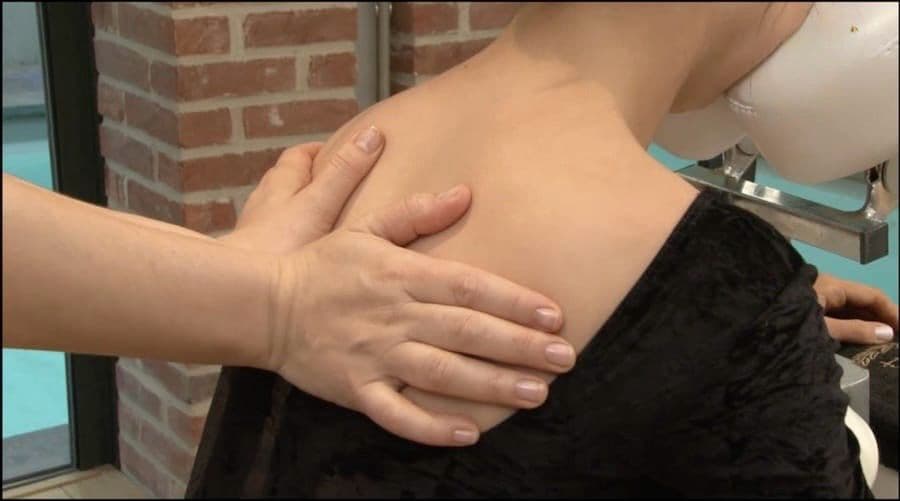
This pressure is applied with the thumbs, fingers, or palms of the hands over the entire body.
This technique stems from Japanese medical knowledge, itself directly inspired by Traditional Chinese Medicine (TCM), in its anatomical and physiological understanding, to treat various functional and organic disorders as a form of preventative medicine.
Traditional Chinese Medicine (TCM) itself originates from Taoism, whose philosophy is to treat the individual holistically, addressing both physiological and psychological aspects.
"Tsubos," or pressure points, are applied to the energy meridians, or specific pathways of Qi.
Qi is the energy that regulates the universe and circulates within the body of every individual; it is the vital energy that keeps the body alive and healthy.
When "Qi" does not flow properly, the energetic balance between Yin and Yang, upon which physical and mental health depends, is disrupted, and symptoms appear.
The goal of Shiatsu is to act by dispersing blockages and tonifying weak areas.
Shiatsu helps to regulate the flow of energy in the body, stimulate the body's self-healing power, and improve health.
The second benefit of shiatsu is that it possesses preventative virtues.
The body's reflex zones and points reveal imbalances in the organs and vital functions to which they are connected. This occurs well before these organs and functions physically manifest their suffering, thus facilitating their identification and rebalancing.
Therefore, depending on the case, it is possible to prevent the appearance of physical symptoms or to significantly alleviate them.
Receiving Shiatsu sessions regularly, even monthly, significantly reduces the risk of excessive fatigue and illness, and preserves emotional and mental harmony.
Shiatsu has applications for relieving or preventing risks in the following health areas:
Psychology, combating anxiety, panic attacks and depression, sexual disorders...
Rheumatology; problems with lumbago, arthritis, stiff neck, osteoarthritis...
Respiration; chronic sinusitis and asthma.
Digestion, soothes vomiting and constipation attacks.
Joint, soothes pain and restores flexibility.
Gynecology, calms morning sickness and menstrual disorders.
In practice, the pressure should be vertical, progressive and continuous, with the aim of tonifying the "Kyo" (energy void) and promoting the diffusion of "Jitsu" (fullness).
Its duration is variable, it stimulates the parasympathetic function of the autonomic nervous system, ensuring the relaxation of the organs and that of the entire body.
The practitioner's two hands must be placed continuously on the patient's body, in order to promote the rebalancing of energy flow in the body.
This means that when a maneuver is performed with only one hand, the other hand must always be placed on the body of the person being massaged.
Each maneuver is generally performed in 3 passes, that is to say in 3 times, so that the body has time to understand and assimilate the stimulus transmitted to it by the practitioner.
The massage technique offered here corresponds to the first level of instruction, which could be described as a basic level.
It is usually practiced in 30 to 45 minutes.
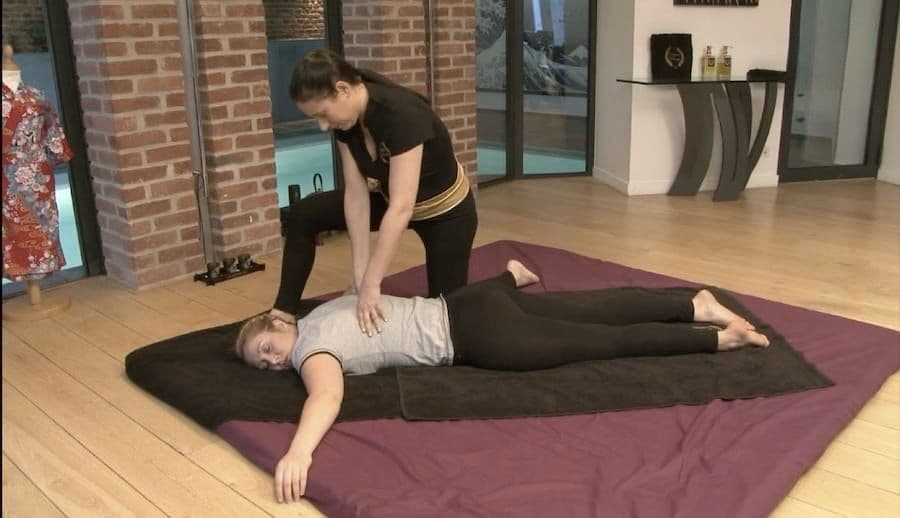
The person being massaged should be comfortably positioned on a massage futon or thin mattress, lying face down. Ensure the person's body is correctly positioned; their spine should be aligned, and their arms and legs should be extended in a comfortable position that respects their body shape.
If you have a pillow, do not use it at this stage of the massage to avoid straining the neck. The person being massaged should remain flat and stable.